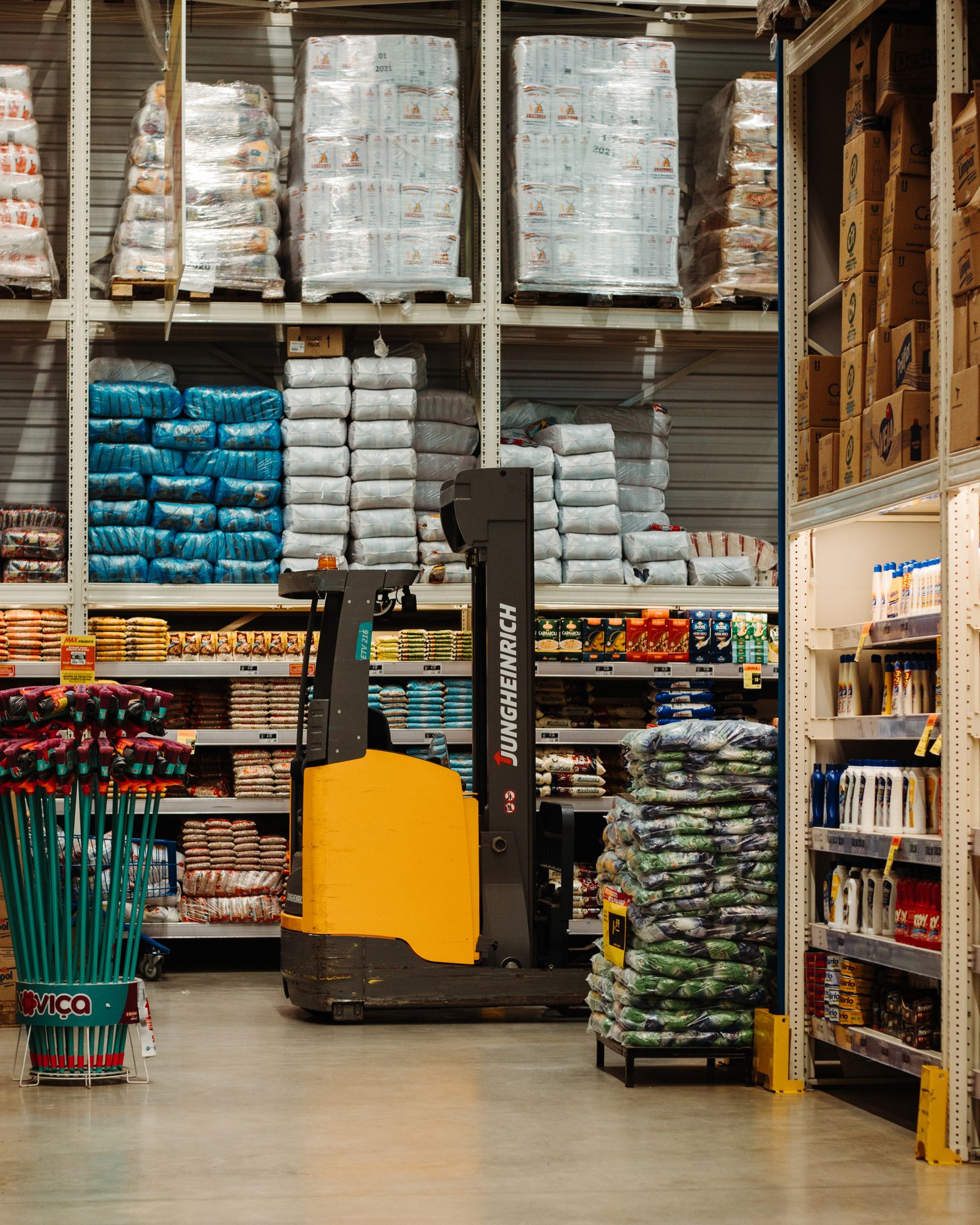
Problems
Here's what operational failure actually looks like on the floor.
Not a list of abstract inefficiencies. Four specific, recurring failures, seen from ten years of actually working around them, not consulting on them from the outside.
Not a list of abstract inefficiencies. Four specific, recurring failures, seen from ten years of actually working around them, not consulting on them from the outside.
Nationally, 32% of people who started a job in the last two years say they're planning to quit within six months, rising to 48% among people who had a poor onboarding experience (Software Finder, Onboarding Crisis Report). The first few weeks on a warehouse floor are exactly that kind of make-or-break window. A new starter who makes a mistake, has a near miss, or damages something is often more worried about how it looks than about the incident itself, and quietly decides it's easier to leave than to own up to it.
That instinct isn't rare, and it isn't limited to new starters either. Research carried out for the UK Health and Safety Executive found that only 30% of workplace injuries among the workers interviewed were ever formally reported (HSE-commissioned research, Royal Liverpool University Hospital), which means the true number of accidents, near misses, and damage that never reach anyone who could act on them is almost certainly far higher. Every one of those unreported incidents is a missed chance to fix the actual cause, and for a new starter with nobody clearly responsible for hearing it, staying quiet and leaving is often the path of least resistance.
The knock-on effect: UK employers lose an average of £30,614 per employee replaced (Starmind, Productivity Drain Research Report), and each replacement is usually covered by an agency worker at a premium rate while the search for someone permanent drags on. Two things would help close that gap: a straightforward way for a new starter to flag a mistake, a near miss, or a bit of damage to the right person without a face-to-face confrontation, and a floor-side induction assistant that can answer the basic day-to-day questions in real time, and knows to hand off to a person the moment it can't answer one safely.
A driver pulls in and rings the only number on the booking-in sheet, the office landline. Whoever would normally answer is mid-task somewhere else on site, so it rings out. Rather than sit and wait, the driver gets out and starts asking around: warehouse staff, other drivers, whoever happens to be walking past, most of whom don't actually know the gate code, which bay is free, or where he's supposed to be either.
It's worse on nights. A site without round-the-clock security or dedicated gate staff leaves a night-shift driver with genuinely nobody official to ask, so the search continues on foot around an active yard, in the dark, among reversing vehicles and forklifts. Being struck by a moving vehicle is one of the leading causes of workplace death in Great Britain, accounting for 16% of all fatal work injuries and an average of 21 deaths a year over the past five years, with transport and storage among the sectors most affected (HSE, workplace fatal injury statistics). A driver on foot hunting for someone to ask is exactly the kind of pedestrian-in-an-active-yard situation that risk sits in.
The same gap creates a second, sharper risk: a driver checking on their own trailer by pulling back the loading bay curtain and putting their head into a bay while it's still being loaded by a PPT or forklift. The operator's attention is on the pallet and the load, not on someone appearing at the trailer end, and a pedestrian sharing space with powered industrial trucks in a confined bay is exactly the kind of scenario workplace transport guidance exists to prevent. How sites handle it varies wildly, some let it slide as routine, others end in a manager shouting at the driver on the spot, but neither response fixes the reason he felt he had to check for himself in the first place.
The knock-on effect: time lost every time a driver can't get an answer without leaving the cab, staff pulled off their own tasks to field a question they've already answered five times that shift, and a genuine safety and insurance risk stacked on top. Employers' Liability insurance is compulsory, but it only covers a fraction of what an incident actually costs: HSE's own costing model puts uninsured losses at £8 to £36 for every £1 recovered from insurers, with the average workplace injury costing around £10,000 once everything is counted (HSE, Costs to Britain of Workplace Injuries and Ill Health). A middleman a driver can message any time, day or night, that answers routine questions instantly, tells him the moment a bay's been flagged clear by whoever's loading it, and knows when to hand something unusual to a person, removes the need to go looking for anyone, or checking for himself, in the first place.
A driver hands over a signed POD or delivery note at the gate. It goes into a pocket, a clipboard, a pile on a desk, there's rarely a scan or a log at the point it's actually received. UK transport and logistics managers spend an average of 1.7 hours every single day manually processing paperwork like this, working out to roughly £51,460 a year in lost time per manager (Microlise, Standing at the Crossroads: A Crucial Moment for UK Logistics). Nobody specifically owns "make sure this gets filed", so it depends on whoever happens to notice the pile is there.
A week later, a query comes in about a delivery. Now someone has to physically dig through a stack of paper, or ask around the site who was on shift that day and might remember. It's common enough that almost seven in ten transport and logistics managers report customer complaints caused by something as simple as illegible handwriting on a paper delivery note (Microlise, Standing at the Crossroads). Incident reports follow the same pattern: written up hours after the fact from memory, missing the details that would have made them useful.
The knock-on effect: once reprocessing and admin are counted, a single failed or disputed delivery costs around £13.50 (HubBox, failed-delivery cost data), stacked on top of the £51,460 a year already lost to manual processing before anything's even gone wrong. A driver photographing and uploading a POD the moment it's signed, matched and filed automatically against the right order, removes the pocket, the pile, and the week-later scramble entirely, and turns "did this actually happen, and can you prove it" into something answered in seconds instead of days.
A warehouse management system, a spreadsheet, a WhatsApp group, and a paper log, none of which talk to each other. It's the industry norm rather than the exception: only 40% of UK transport and logistics managers say they work from a single, all-in-one system, meaning most are juggling more than one disconnected tool to do the same job (Microlise, Standing at the Crossroads: A Crucial Moment for UK Logistics). The same piece of information gets entered two or three times in two or three places, by whoever remembers to do it, in whatever order the shift allows.
A stock discrepancy shows up because someone updated the spreadsheet but not the system, or vice versa, and now nobody's sure which number is actually right. Someone has to walk the aisles with a clipboard to find out, days after the discrepancy first appeared, by which point it's harder to trace back to what caused it.
The knock-on effect: UK retail lost roughly £9 billion to stock shrinkage in 2025 (NetSuite UK, Retail Shrinkage Report), and a meaningful part of that is exactly this: nobody trusting any single system enough to stop double-checking everything manually. A discrepancy flagged the moment it shows up in the data, rather than days later on a clipboard walk, catches the problem while it's still cheap and easy to trace back to its cause, instead of after it's already become a write-off.
If a task like this takes 15 hours a week across 2 people, at roughly £18/hour loaded cost, over 48 weeks, that's approximately £12,960 a year, before any automation is involved.
This doesn't mean automation saves this exact amount, it's a starting point for deciding whether a process is worth investigating. Figures above are sector-wide and illustrative, not specific to any one site.
Want to see what fixing one of these actually looks like, in practice, on a real shift?
See demonstration workflows